


Principles Of Food science Lab (11:400:202)
Credit: 2
Prerequisite:
Principles of Food Science (11:400:201)
Time & Place:
Office Hours: By appointments
For appointments:
call / email
Instructor:
Karen M. Schaich, Sc. D.
schaich@sebs.rutgers.edu
65 Dudley RD, Room 315D
(848) 932-5454
(732) 932-6776
Class schedule: https://sis.rutgers.edu/soc/#home.
COURSE WEBSITE, RESOURCES AND MATERIALS:
All of the materials that you will need for this course will be posted in the class Canvas website https://tlt.rutgers.edu/canvas. Textbook: There is NO mandatory textbook required for this course.
COURSE DESCRIPTION:
Fundamental roles of physical properties and chemical reactions of proteins, lipids, and carbohydrates in food systems; principles underlying food function and stability; analysis of food properties.
Corequisite Students registering for this lab course must be registered for Principles of Food Science 11:400:201 OR must have completed it previously.
LEARNING GOALS
Course Learning Goals
At the end of the course, students will
- Become familiar with food preparation and processing operations, physical and chemical characteristics of foods, some analytical methods, and food behaviors under different conditions.
- Observe fundamental science concepts at work in food materials, learn to apply theory from lecture to real foods.
- DUse scientific method in investigating properties and changes in foods.
- Develop a basic understanding of food composition and structure/function/behavior relationships, relating molecular properties to food characteristics, quality, and microbial utilization.
- Develop skills in summarizing and communicating scientific research simply and succinctly.
ASSIGNMENTS/RESPONSIBILITIES, GRADING & ASSESSMENT:
- Each student must print out lab instructions and bring them to lab in a notebook or binder.
- Loose lab sheets will not be permitted. You will be sent home for a notebook and lose points for class participation.
- Some support materials will be posted on the Canvas course site.
- Additional references books and journals with supporting information are available in Chang Library. Students are encouraged to read broadly about the topics covered in the lab exercises, using whatever authoritative sources will help them understand the concepts.
- For in-person students, there will be a course fee of $35.00 (preferably cash) to cover costs of lab supplies and lab coats. Pay Dr. Schaich directly, preferably in cash. (You will also get to take home foods prepared in lab.)
COURSE REQUIREMENTS:
- Read lab exercise and background before each class. It is critical that you understand what is to be done so the experiments proceed without problems.
- Complete pre-lab question sheets posted on Canvas and submit as WORD files on-line before beginning of lab.
- YOU WILL NOT BE ADMITTED TO LAB WITHOUT COMPLETED PRE-LAB WORKSHEETS!
- ***Off-campus students will be blocked from the filming and recording until Pre-labs are submitted
- Attend lab and complete lab experiments each week.
- In-lab: student groups together perform the variations for each experiment, record all data where indicated in the lab notes. Calculate and compile data, load into data file that will be posted in the Canvas course site.
- Examples of lab reports are posted on Canvas site.
- Reports are due one week after completion of lab. Upload as Word file to Canvas under Assignments.
- Points will be deducted for late reports at the rate of 2 points per day unless extensions are granted beforehand by the professor.
- ***This is a 2 CREDIT lab course, so be prepared to spend the full time in each lab period to allow for clean-up and discussion of results before leaving.
*Participation in-class includes preparedness, cooperation, organization, attitude, clean-up. Participation on-line includes home product contributions.
- There are no make-up labs.
- If you have a health or family emergency, notify Dr. Schaich by email BEFORE the lab starts.
SAFETY
- All students are expected to wear safety glasses, lab coats, gloves and hair covering during all labs.
- Wear approved safety glasses for all labs (you will not be admitted to class without them -- you each must purchase your own from bookstore, Home Depot, etc., keep track of them, and bring them to each lab).
- Lab coats and hair covers will be provided (part of your lab fee). These are required to cover your clothes and prevent contamination of foods from outside microbes. Thus, lab coats can only be worn in class. Remove whenever you leave the laboratory.
- Gloves will be provided in class when needed
HAND WASHING AND HAIR
- Disease is transferred rapidly by hand contact.
- Because everyone will share in tasting the foods prepared in each lab, students are required to wash their hands with soap and hot water at the dedicated handwashing station in the pilot plant before handling food.
- If you remove your gloves and handle clothes, back packs, etc, or leave the pilot plant during the lab, you must wash your hands again before handling food ingredients
CLOTHING
- Appropriate attire must be worn at all times.
- This means slacks (preferably, although knee-length skirts will be allowed) and closed-toe shoes.
- Sandals, shorts, skimpy tops, or other clothing deemed unsafe and unprofessional are not allowed.
- Students wearing such attire will be sent home to change, with deduction of participation points.
LAB NOTEBOOKS
- Print lab exercises and compile in a 3-ring binder.
- Bound notebooks with lab directions should be brought to each lab and used for all records; data should NOT be recorded on scraps of paper and then transferred to the notebook.
- Do not tear out pages. If errors are made, cross them out and note what the error was. Do not bring single pages of lab instructions to class.
LAB REPORT FORMAT
General Information:
- Reports are due one week after completion of laboratory. Two points are deducted for each day late. If you have a problem completing the lab for any reason, see Dr. Schaich. Reports will not be accepted beyond one week past due date unless a formal extension is granted from Dr. Schaich.
- Write reports in past tense
- DWrite in third person. Do not use personal pronouns I, We, you.
- Type reports in a PC Word file, single spaced, 1 inch margins.
- Submit reports on Canvas under ASSIGNMENTS
Report Structure: Approximately 5 page summary of laboratory and observations Include:
- Title of laboratory
- Student name
Group # and Names of all other students in research group (or version of experiment performed at home)
date lab was conducted
date lab was due and date submitted - Introduction: General description of the purpose of the lab with some background on the scientific principles involved
- Methods: General description of the methods used and what each is to accomplish. Step by step details of methods are not required. However, note any changes from conditions prescribed in lab write-up. On-line students: describe the version you tested and what adjustments were necessary for working at home.
- Results and Discussion:
- Present key data that illustrates principles studies in the lab
- Integrate the data posted on Canvas for all 7 variations of the experiment to show how varying conditions or composition changes structures and properties of foods.
- Manipulate and present data so you can tell a story about the science involved, write a logical discussion, and present supporting evidence.
- Transform raw data to a graphical form that shows the relationships you want to discuss. Examples are shown on the next page. You may use Excel, MatLab, or any other program with which you are familiar.
- If you need help with software, contact a TA or the Rutgers computer lab. Make sure you label both axes of graphs.
- Along with graphs, describe results verbally and discuss what they mean and what they show in terms of scientific principles, whether they followed expectations, and possible reasons for discrepancies. “Other groups made mistakes” is not an acceptable explanation
- Describe the mistake and the consequences. For example: balances were not tared so weights were inaccurate. pH electrodes were not cleaned between jelly samples so calibration drifted. Make a significant effort to sort out the data and find points to demonstrate the principles being studied
- Questions at the end of each lab section are specifically focused on important issues and principles you should recognize. Answers to questions should be incorporated into the discussion of results.
- Goals of exercise were to study effects of freezing rate on ice crystal size and resulting damage to products.
- We cannot measure ice crystal size but we can deduce the size from extent of damage from them based on the assumption that larger ice crystals caused more damage to cells, and hence greater release of cell liquids (drip loss).
- In addition, acids are released and tissues become exposed to air, both of which can later pigments.
- Cell damage leads to collapse of tissues after the sample is thawed.
- These effects can be seen in increased drip loss, color changes (red color fades – lightness (L) increases and red color (a) decreases), and texture deterioration (lower scores, increasing mushiness) in samples with slower freezing rates (chest freezer)
- Conclusions: Briefly summarize what was learned from the experiment. "Data was chaos" is not an acceptable summary. Relate the key points that demonstrate scientific principles and are related to the objectives of the experiment.
- References. List all references cited in the report. Any format may be used as long as consistency is maintained, e.g. see style guides for authors in J. Food Science, Cereal Science, J. Agric. and Food Chemistry.
Examples of how to develop graphs from raw data:
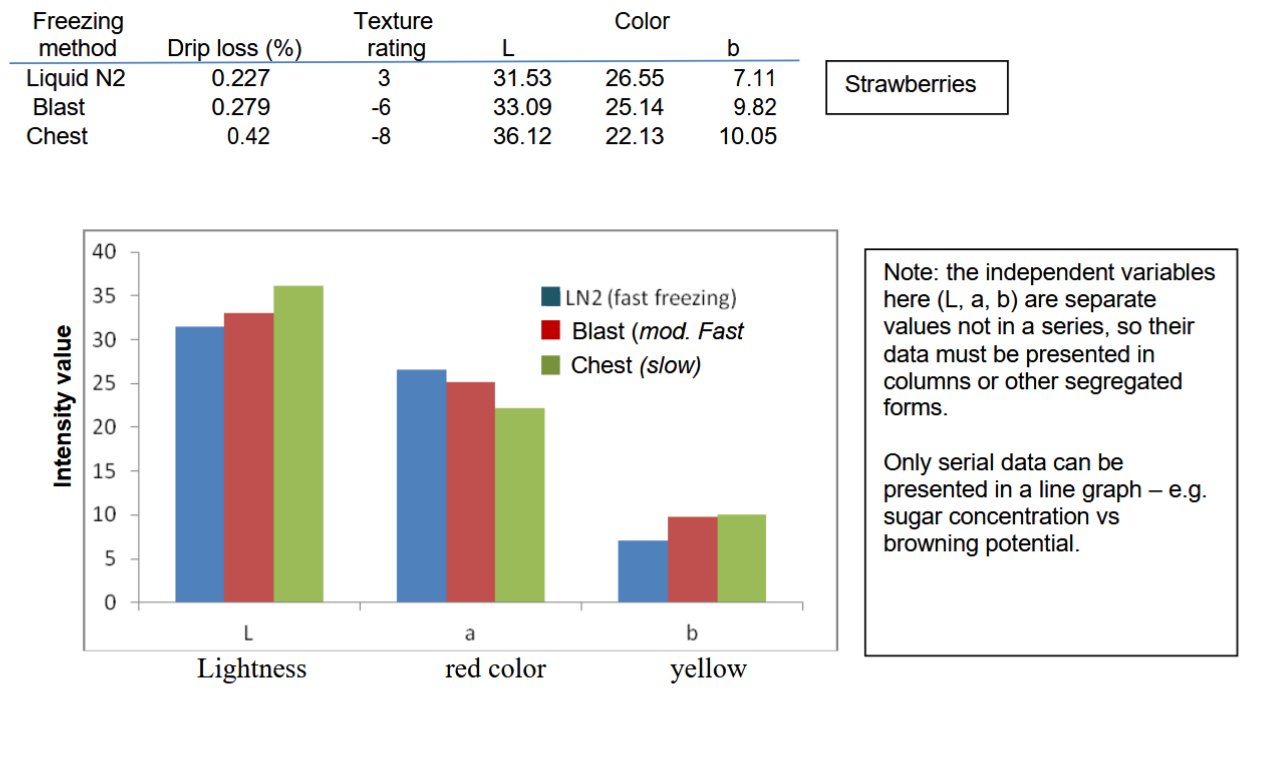
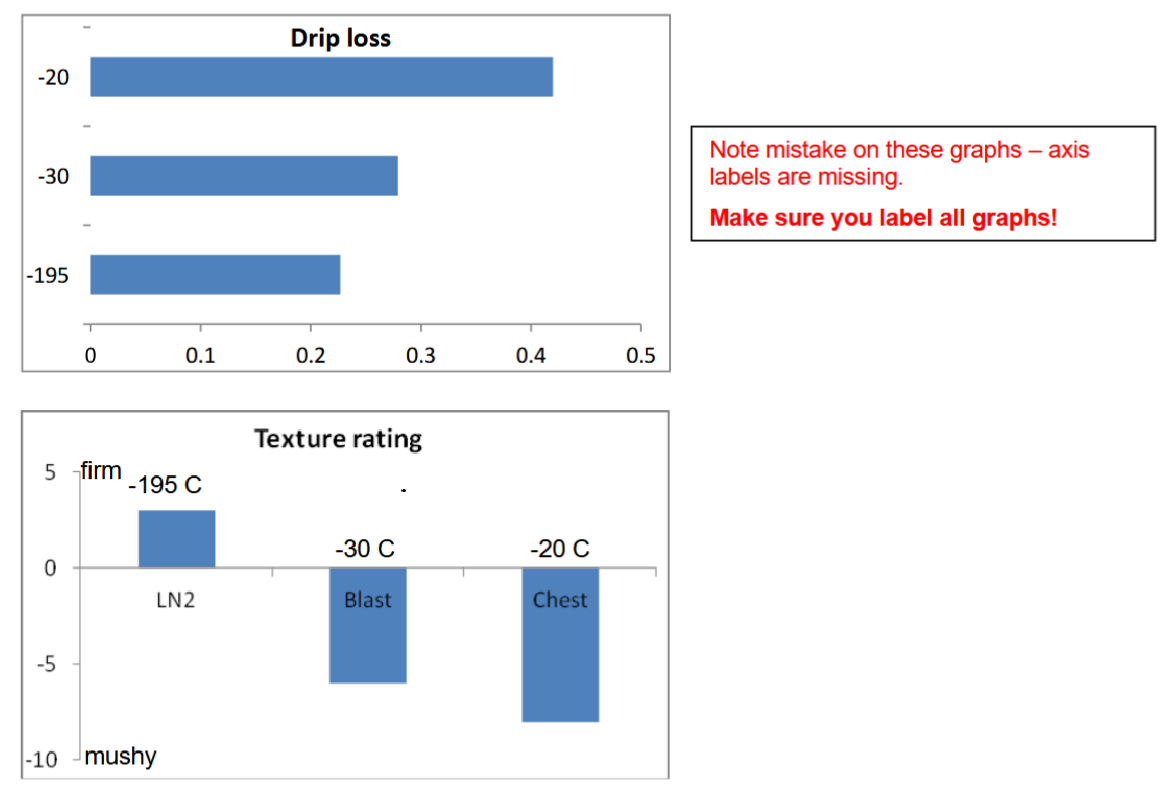
What can you learn from this data?
Extra points will be awarded for lab reports that go beyond listed questions and course notes to integrate additional outside material relevant to the laboratory, including explanations or observations from “Good Eats” or “Food Detectives” (with appropriate citations) or from journal articles or books in the library.
LABORATORY SCHEDULE
Final Exam/Paper data and Time: Online Final Exam Schedule.
ACCOMODATIONS FOR STUDENTS WITH DISABILITIES
Please follow the procedures outlined at Rutgers Office Of Disability services Registration form. Full policies and procedures are found in the Rutgers Office Of Disability services website.
The Rutgers Office Of Disability services is located at Lucy Stone Hall, Suite A145, Livingston Campus, 54 Joyce Kilmer Avenue, Piscataway, NJ 08854. The contact phone number is (848) 445-6800.
Rutgers University welcomes students with disabilities into all of the University's educational programs. In order to receive consideration for reasonable accommodations, a student with a disability must contact the appropriate disability services office at the campus where you are officially enrolled, participate in an intake interview, and provide documentation at Rutgers Office Of Disability services documentation Guidelines website. If the documentation supports your request for reasonable accommodations, your campus’s disability services office will provide you with a Letter of Accommodations. Please share this letter with your instructors and discuss the accommodations with them as early in your courses as possible. To begin this process, please complete the Registration form on the ODS web site at: Rutgers Office Of Disability services Registration form.
Absence Policy
The University does recognize that temporary conditions and injuries can be problematic and may adversely affect a student’s ability to fully participate in class.
Absences or making up work go to Temporary Conditions website for detail.
The Dean of Students Office at Rutgers University-New Brunswick provides solutions, services, and support to help students navigate Rutgers University. By focusing on students’ educational, social, and personal development, staff in the Office promote academic success and student retention. The Office serves as a student support network by providing advocacy, problem resolution, and critical incident intervention for those times when additional assistance is needed.
- Self-Reporting Absences: For absences in class or labs less than a week that are not confidential in nature, students need to inform faculty directly by using the Absence Reporting System (ARS).
- Longer Periods of Absence: If you anticipate missing more than one week of classes for serious illness, confidential, or sensitive personal reasons, you should also consult with a New Brunswick Dean of Students who will help to verify your extended absences from classes.
- Absences due to illnesses: If your absence is due to illness, visit New Brunswick Health Services for information about campus health services, including information about: how to make an appointment, self-care advice for colds/flu, mental health and counseling options.
ACADEMIC INTEGRITY
The university's policy on Academic Integrity requires that a student:
- properly acknowledge and cite all use of the ideas, results, or words of others.
- properly acknowledge all contributors to a given piece of work.
- make sure that all work submitted as his or her own in a course or other academic activity is produced without the aid of impermissible materials or impermissible collaboration.
- obtain all data or results by ethical means and report them accurately without suppressing any results inconsistent with his or her interpretation or conclusions.
- treat all other students in an ethical manner, respecting their integrity and right to pursue their educational goals without interference. This requires that a student neither facilitate academic dishonesty by others nor obstruct their academic progress.
- uphold the canons of the ethical or professional code of the profession for which he or she is preparing.
Adherence to these principles is necessary in order to ensure that
- everyone is given proper credit for his or her ideas, words, results, and other scholarly accomplishments.
- all student work is fairly evaluated, and no student has an inappropriate advantage over others.
- the academic and ethical development of all students is fostered.
- the reputation of the University for integrity in its teaching, research, and scholarship is maintained and enhanced.
Failure to uphold these principles of academic integrity threatens both the reputation of the University and the value of the degrees awarded to its students. Every member of the University community therefore bears a responsibility for ensuring that the highest standards of academic integrity are upheld.
Cheating and Plagiarism
(From Spring 2010 Andy Egan 01:730:252 Eating Right): "Cheating on tests or plagiarizing materials in your papers deprives you of the educational benefits of preparing these materials appropriately. It is personally dishonest to cheat on a test or to hand in a paper based on unacknowledged words or ideas that someone else originated. It is also unfair, since it gives you an undeserved advantage over your fellow students who are graded on the basis of their own work. In this class we will take cheating very seriously".
Turnitin will be used to assess students‚ submissions and all suspected cases of cheating and plagiarism will be automatically referred to the Rutgers Academic Integrity office.
Counseling, ADAP & Psychiatric Services (CAPS)
Counseling, ADAP & Psychiatric Services (CAPS) located at 17 Senior Street, New Brunswick, NJ 08901 is a University mental health support service that includes counseling, alcohol and other drug assistance, and psychiatric services staffed by a team of professional within Rutgers Health services to support students’ efforts to succeed at Rutgers University. CAPS offers a variety of services that include: individual therapy, group therapy and workshops, crisis intervention, referral to specialists in the community and consultation and collaboration with campus partners. its phone number is (848) 932-7884.
Violence Prevention & Victim Assistance (VPVA)
The Violence Prevention & Victim Assistance (VPVA) phone number is (848) 932-1181, and it is located at 3 Bartlett Street, New Brunswick, NJ 08901
The Office for Violence Prevention and Victim Assistance provides confidential crisis intervention, counseling and advocacy for victims of sexual and relationship violence and stalking to students, staff and faculty. To reach staff during office hours when the university is open or to reach an advocate after hours, call 848-932- 1181.
Disability Services
The Office of Disability Services phone number is (848) 445-6800, and it is located at Lucy Stone Hall, Suite A145 Livingston Campus 54 Joyce Kilmer Avenue Piscataway, NJ 08854
Rutgers University welcomes students with disabilities into all of the University's educational programs. In order to receive consideration for reasonable accommodations, a student with a disability must contact the appropriate disability services office at the campus where you are officially enrolled, participate in an intake interview, and provide documentation at Office of Disability Services Documentation Quidelines website. If the documentation supports your request for reasonable accommodations, your campus's disability services office will provide you with a Letter of Accommodations. Please share this letter with your instructors and discuss the accommodations with them as early in your courses as possible. To begin this process, please complete the Registration Form.
Scarlet Listeners
Scarlet Listeners provides free and confidential peer counseling and referral hotline, providing a comforting and supportive safe space. Call at (732) 247-5555 for more information.